From 28 days to 24 hours: rebuilding company incorporation
EasyBiz helps SMEs in Luxembourg register and run their business. Opening a company in Luxembourg took founders up to 28 days: fragmented stages, endless document uploads, and a compliance process no one could see into.
I redesigned it end-to-end into a transparent, AI-assisted pipeline, and cut registration to under 24 hours, making EasyBiz the first in the country to do it in a day.
Founding product designer
Built the product's design function from scratch:
the design system, website, core features, and marketing, and rebuilt the KYC onboarding that sits at its heart.
Figma, Claude, Gemini, Perplexity
Feb 2024 — Apr 2026

* Outcome
Measured over 2.5 years on the product, from support and marketing data and from interviews and HubSpot analytics with 100+ real users through 2025–26:
28 days → under 24 hours
to complete company registration. Confirmed by the back-office team (see the Slack messages at the end).
−60% KYC process time
I digitised the full document workflow and added auto-validation.
−90% compliance follow-ups
A structured client & supplier registry meant the back office stopped chasing missing answers.
−80% file mismatches
A linear checklist and focused modals cut wrong files and final-stage delays.
* Context & problem
The market standard for incorporation in Luxembourg was 3–4 weeks for a founder to get a business license. The delay was due to disconnected stages and fragmented bureaucracy.
Documents arrived by post, KYC restarted whenever anything expired, and the whole process was a black box no one could see progress through. For founders, losing a month to get a license is an unacceptable risk.
What users faced with
I audited the KYC/KYB requirements for SARL and SARL-S to understand why founders felt overwhelmed. The pain was the total lack of context for complex legal terms.
SARL-S (Simple)
for freelancers, low capital, speed
Minimum capital
From €1 to €12,000.
Legal setup
Standardised articles, no notary required.
Key barrier
Proof of professional qualifications or a relevant academic diploma.
SARL (Standard)
for investors, scalability, structure
Minimum capital
At least €12,000.
Legal setup
Mandatory notarial deed.
Compliance heavy
extensive source-of-wealth verification and UBO KYC.
Universal friction
across all companies
ID & Residency
high-res passport scans, recent utility bills.
Legal clearances
13-digit LNIN, criminal-record extracts.
Physical presence
a valid lease or domiciliation contract in Luxembourg
* Business goals
As the founding designer, I was designing onboarding as a business lever, not just a flow. Four goals shaped the work:
Be the fastest
in the market
The core bet: make EasyBiz the first in Luxembourg to take a founder from start to registered company in 24 hours — a speed no competitor offered, and a reason to choose us.
Acquisition
That speed was the headline that pulled new users in — onboarding had to deliver on the promise the marketing made.
Retention
Onboarding can be brutally long (the first MVP proved it). If founders stalled or dropped mid-flow, we lost them before they ever became customers. So the flow had to carry them through.
Lower support load
(post-MVP)
After the MVP, the goal was an intelligent, AI-assisted onboarding that answered questions and validated inputs itself, so the back office and support weren't manually fixing every application.
* Challenges
Simplifying UX without touching compliance. I had to compress a 28-day cycle into a same-day process while holding 100% compliance with Luxembourg's strict regulatory standards. Speed could not come at the cost of a single legal requirement.
A regulatory problem. KYC/KYB in Luxembourg is genuinely complex: UBO identification, source-of-wealth checks, minimum-capital rules, notary steps. The design had to make that legible to founders without oversimplifying the law.
A black-box process to make transparent. Founders had no visibility into where their application stood. Much of the delay was a transparency problem. The flow had to surface status at every step.
First of its kind, with no blueprint to follow. No product like this existed in Luxembourg, so there was nothing to benchmark against. Every requirement (legal, banking, KYC) I had to be gathered by hand from fragmented, mostly French-language government sources, then translated into a flow no one had designed before.
* My role & approach
As founding designer, I built the design function from scratch: the design system, website, core features, and marketing, and owned KYC onboarding end-to-end, from research through to shipped flow.
I worked directly with engineers and the back-office/compliance team rather than inside a large design org.
Over 2.5 years I ran a repeatable loop, and I could close it with real data:
Audit & frame
Map pains
to the pipeline
Design structurally
Measure
and iterate
* Research
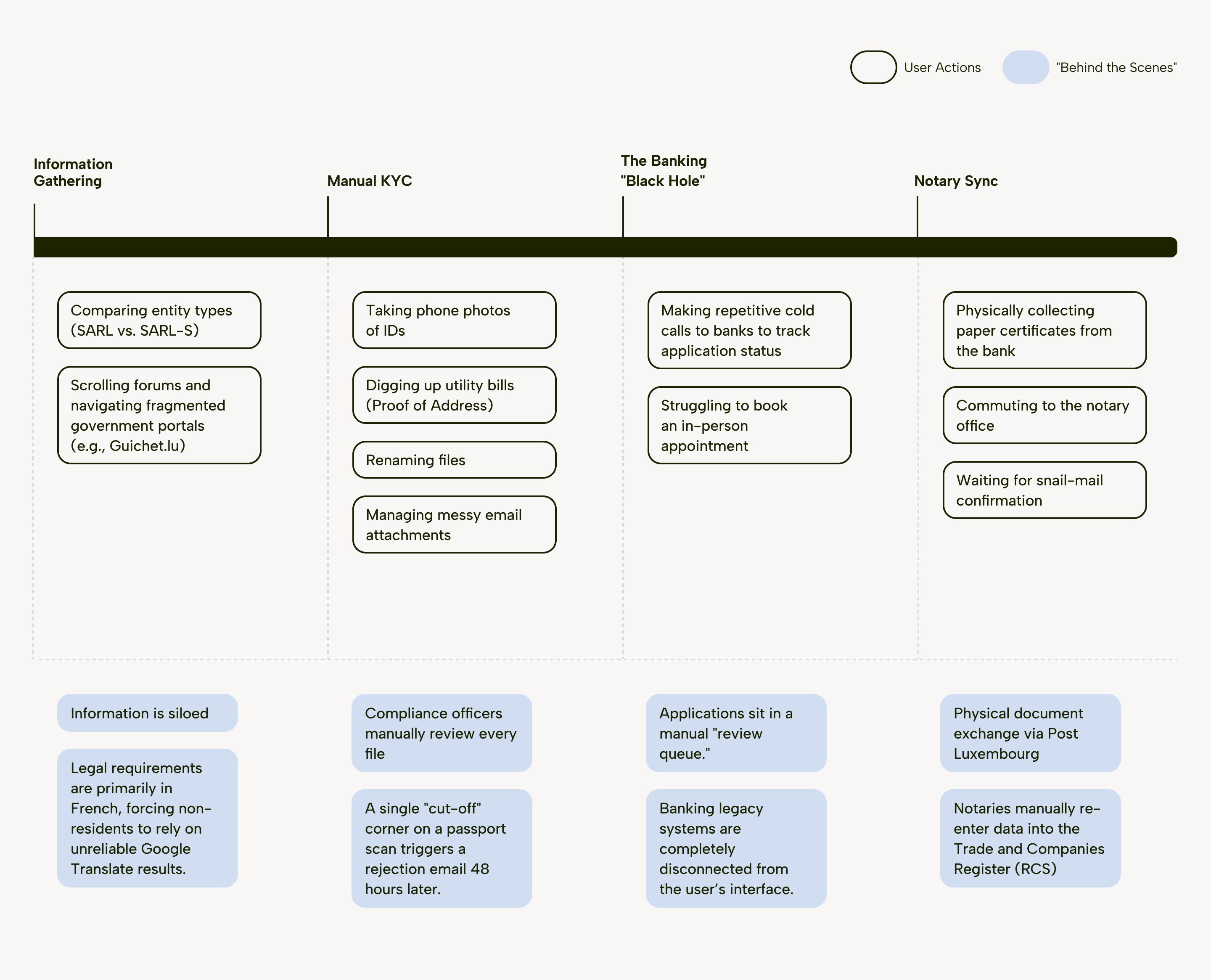
I mapped user actions against the legal and banking hurdles to find the bottlenecks. It revealed the four-week delay was a systemic transparency problem: applications sat in manual review queues, banking systems were disconnected from the interface, and physical documents moved by post.
* Insights
Three patterns shaped the direction:
Data redundancy
Users entered the same address three separate times: for the bank, the notary, and the RBE. The system never reused what it already had.
Rejection loops
The endless circle of KYC: if one document expired mid-process, the entire verification restarted from scratch.
Dead time
The "paper gap" — the platform sat idle for days while physical copies arrived by post.
The pivotal insight
A black box was a workload problem. Founders couldn't see where they stood, and the system couldn't reuse or validate anything on its own.
Reframed the goal: turn incorporation from an opaque, restart-prone ordeal into a transparent, self-validating 24-hour pipeline.
* Iterations & Tests
I worked in three focused loops, each starting
from a hypothesis and ending with what real use revealed.
Initial hypotheses
3 prioritised name variants and structured descriptions upfront will let accountants verify instantly.
Insight
Collecting data wasn't enough. The form had to validate it. Without that, every submission became a support ticket.
Automated business validation
Activity-based filters route users instantly to a "Success" or "Legal Rejection" path — no late-stage drop-offs.
Result
Front-loading rejection turned onboarding into a diagnostic tool that filters non-compliant applications instantly, before they reached the back office.
Trade-off
An upfront rejection path risks stopping some edge-case-valid users early. I accepted that in exchange for keeping the vast majority out of slow, manual review.
"Blank Page" problem
A single "Master Entry" automates service selection, less manual work for accountants.
Insight
Founders lacked the structure to express them. A blank page produced anxiety.

New direction
Categorized presets solve the "blank page" problem. Users define company goals faster and more accurately.
Result
Presets removed blank-page anxiety and made every submission machine-readable: unlocking instant cost estimates without human intervention.

Trade-off
Presets constrain the edges of what a founder can express. A deliberate call that guided structure beats a blank page for both users and the automation behind it.
High-level financial estimates
A single-screen interface for financial totals will lower cognitive load and increase completion versus multi-step forms.
Insight
Without a breakdown, annual totals were guesses. Guesses don't pass compliance checks.

From guesswork to
audit-ready data
I modelled counterparty details (incoming/outgoing funds, countries, purpose) to eliminate invalid entries by design, turning abstract guesses into audit-ready data.
Result
Structured counterparty data cut compliance follow-ups by ~90% and unlocked fully automated service pricing.
This information will help us better understand your business.
If you don't have specific client or supplier names yet, please provide their country, industry, or category.
| Client | Description of service provided | Amount annually | Client's country | Type |
|---|
| Supplier | Description of service received | Amount annually | Supplier's country | Type |
|---|
Trade-off
Asking for granular data upfront adds fields to the form: justified because vague totals simply failed compliance downstream and generated the follow-ups we were trying to kill.
Unified table
Displaying all equity and share data on a unified screen will eliminate navigation friction and prevent data-entry errors.
Insight
Math and personal data entry don't mix. Asking users to do both simultaneously produced errors in both.

Real-time validation
Live validation will enforce the €12,000 minimum capital rule and ensure share distribution always totals exactly 100%.
Insight
Luxembourg law distinguishes between people and companies. The table didn't — and that caused errors.

Surfacing legal limits early
Structured inputs will allow accountants to spot legal restrictions upfront, reducing the risk of official registration rejections.
Result
Hiding the legal math cut time-on-task by 40% and kept users moving through the funnel.


Trade-off
Automating the math means users see less of the underlying calculation. I kept the totals visible so nothing felt hidden, without making them do the arithmetic.
Unified chaos
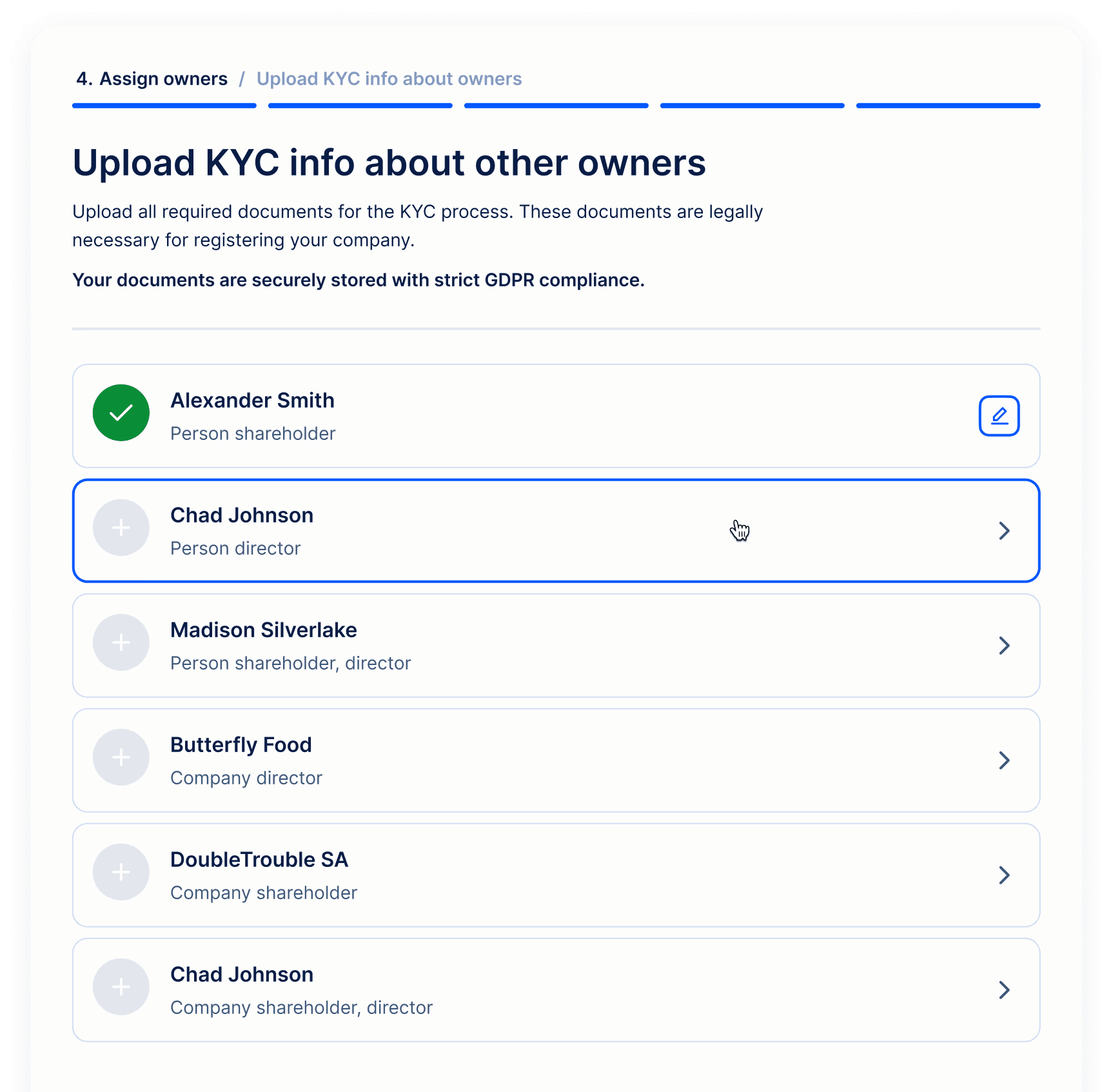
Grouping uploads by participant (UBO, Manager, Shareholder) prevents "wrong file" errors and helps users match documents to the right person.
Insight
Three legal roles, one screen, no hierarchy. Users couldn't build a mental model of their own company structure.

Segmented roles
Triggering a "Nested Ownership" flow for corporate shareholders clarifies the legal need to identify the individuals behind each entity.
Insight
Better structure, same jargon. Users knew where to click but not what "UBO" meant and that was enough to stop them.

Humanized copy
I turned abstract legal requirements into plain-language questions and clear rules, so users understood what UBO data to provide and why.
Result
Once users understood why UBO data was needed, completion rates recovered.

Trade-off
The nested flow adds steps for companies with complex ownership — unavoidable, since the law itself is nested; the win was making that complexity legible instead of hiding it.
The consolidated grid
Displaying all upload fields on one page gives users a full overview and lets them complete uploads in any order.
Insight
Every upload was a guess without clear ownership. This final step was also the most fragile: a single mismatched document could delay registration by weeks.

Rebuilding the data-heavy steps for mobile
I redesigned the stage around one principle: make the right action the only action with per-person linear progress and focused modals.
Result
Per-person checklists reduced file mismatches by ~80% and cut drop-offs at the highest-risk point in the funnel.

Trade-off
A strict linear checklist gives power users less freedom to jump around. At this stage, freedom was exactly what caused the costly mismatches.
* Mobile version
I designed a distinct flow for each data type. Founders could complete the entire incorporation flow on a phone without the desktop tables and multi-column forms that made those steps impossible on mobile.
Funds
Two required independent streams. Users add at least one counterparty to each, returned as summary cards.
Shareholders
Created from scratch, with percentage and share amounts entered inline, since shares must total exactly 100%.
Directors & UBO
Selected from people already entered, with an "authorized person" flag rather than re-entering anyone.
Trade-off
A mechanic per data type meant more patterns to design and maintain than one uniform list. I accepted that cost because forcing structurally different data into one identical flow was exactly what confused users about their own company and finances.
* The proof
The redesign worked faster. My team tracked the impact on internal processing speeds and user completion rates, and the back office started logging what they called "Guinness Records". Real internal Slack messages from the back-office team; names removed:


* Learnings
The strongest lesson: on a compliance product, structure carries the outcome more than copy. The delays disappeared because the flow validated, sequenced, and reused data on its own. And real HubSpot analytics into Slack every morning, plus interviews with 100+ users, are what let me prove that.
What I'd do differently
I'd go deep on Luxembourg compliance and law from day one. The first MVP was built fast, right after I joined and before I fully understood the regulatory details. It showed that early onboarding worked badly. Understanding the law earlier would have saved a whole rebuild.
I'd push for analytics from the very start. Early on, all I had was interview footage with back-office staff — not real users. Instrumenting the product from day one would have grounded the first decisions in real behaviour.
I'd validate with real founders sooner. The internal team understood the process too well, but first-time founders were the ones actually getting stuck. Testing with them earlier would have surfaced the black-box problem before launch.

From 28 days to 24 hours: rebuilding company incorporation
EasyBiz helps SMEs in Luxembourg register and run their business. Opening a company in Luxembourg took founders up to 28 days: fragmented stages, endless document uploads, and a compliance process no one could see into.
I redesigned it end-to-end into a transparent, AI-assisted pipeline, and cut registration to under 24 hours, making EasyBiz the first in the country to do it in a day.
Founding product designer
Built the product's design function from scratch: the design system, website, core features, and marketing, and rebuilt the KYC onboarding that sits at its heart.
Figma, Claude, Gemini, Perplexity
Feb 2024 — Apr 2026
* Outcome
Measured over 2.5 years on the product, from support and marketing data and from interviews and HubSpot analytics with 100+ real users through 2025–26:
28 days → under 24 hours
to complete company registration. Confirmed by the back-office team (see the Slack messages at the end).
−60% KYC process time
I digitised the full document workflow and added auto-validation.
−90% compliance follow-ups
A structured client & supplier registry meant the back office stopped chasing missing answers.
−80% file mismatches
The product had to hold up as users grew from a handful of invoices to hundreds, so the company could scale without a rebuild
* Context & problem
The market standard for incorporation in Luxembourg was 3–4 weeks for a founder to get a business license. The delay was due to disconnected stages and fragmented bureaucracy.
Documents arrived by post, KYC restarted whenever anything expired, and the whole process was a black box no one could see progress through. For founders, losing a month to get a license is an unacceptable risk.
What users faced with
I audited how three market leaders: Finom, Qonto, and Billy,handle the core invoicing jobs. I wanted to see where each draws the line between compliance and usability, and where EasyBiz could do better.
I also studied broader accounting products like Odoo: functionally deep, but visually heavy and hard to act in quickly. That contrast set the bar: EasyBiz could win
on clarity where the incumbents won on features.
SARL-S (Simple)
for freelancers, low capital, speed
Minimum capital
From €1 to €12,000.
Legal setup
Standardised articles, no notary required.
Key barrier
Proof of professional qualifications or a relevant academic diploma.
SARL (Standard)
for investors, scalability, structure
Minimum capital
At least €12,000.
Legal setup
Mandatory notarial deed.
Compliance heavy
extensive source-of-wealth verification and UBO KYC.
Universal friction
across all companies
ID & Residency
high-res passport scans, recent utility bills.
Legal clearances
13-digit LNIN, criminal-record extracts.
Physical presence
a valid lease or domiciliation contract in Luxembourg
* Business goals
Invoicing was a module SMEs touched every week that made it a lever for the business. Four goals shaped the work:
Be the fastest
in the market
The core bet: make EasyBiz the first in Luxembourg to take a founder from start to registered company in 24 hours — a speed no competitor offered, and a reason to choose us.
Acquisition
That speed was the headline that pulled new users in — onboarding had to deliver on the promise the marketing made.
Retention
Onboarding can be brutally long (the first MVP proved it). If founders stalled or dropped mid-flow, we lost them before they ever became customers. So the flow had to carry them through.
Lower support load
(post-MVP)
The product had to hold up as users grew from a handful of invoices to hundreds, so the company could scale without a rebuild
* Challenges
Simplifying UX without touching compliance. I had to compress a 28-day cycle into a same-day process while holding 100% compliance with Luxembourg's strict regulatory standards. Speed could not come at the cost of a single legal requirement.
A regulatory problem. KYC/KYB in Luxembourg is genuinely complex: UBO identification, source-of-wealth checks, minimum-capital rules, notary steps. The design had to make that legible to founders without oversimplifying the law.
A black-box process to make transparent. Founders had no visibility into where their application stood. Much of the delay was a transparency problem. The flow had to surface status at every step.
First of its kind, with no blueprint to follow. No product like this existed in Luxembourg, so there was nothing to benchmark against. Every requirement (legal, banking, KYC) I had to be gathered by hand from fragmented, mostly French-language government sources, then translated into a flow no one had designed before.
* My role & approach
I was the sole designer on the product and owned invoicing
end-to-end: competitor audits and user research, flows and information architecture, UI and interaction, and the design system I built and maintained solo.
Working solo on a live product, I built a loop I could run fast and repeat:
Audit & frame
Map pains
to the pipeline
Design structurally
Measure
and iterate
* Research
I mapped user actions against the legal and banking hurdles to find the bottlenecks. It revealed the four-week delay was a systemic transparency problem: applications sat in manual review queues, banking systems were disconnected from the interface, and physical documents moved by post.
* Insights
Three patterns shaped the direction:
Data redundancy
Users entered the same address three separate times: for the bank, the notary, and the RBE. The system never reused what it already had.
Rejection loops
The best tools separate document collection from review. Finom's two-step flow: "Upload first, review later", cuts misclicks and cognitive load.
Dead time
The "paper gap" — the platform sat idle for days while physical copies arrived by post.
The pivotal insight
A black box was a workload problem. Founders couldn't see where they stood, and the system couldn't reuse or validate anything on its own.
Reframed the goal: turn incorporation from an opaque, restart-prone ordeal into a transparent, self-validating 24-hour pipeline.
* Iterations & Tests
I worked in three focused loops, each starting from a hypothesis and ending with what real use revealed.
Initial hypotheses
3 prioritised name variants and structured descriptions upfront will let accountants verify instantly.
Insight
Collecting data wasn't enough. The form had to validate it. Without that, every submission became a support ticket.
Automated business validation
Activity-based filters route users instantly to a "Success" or "Legal Rejection" path — no late-stage drop-offs.
Result
Front-loading rejection turned onboarding into a diagnostic tool that filters non-compliant applications instantly, before they reached the back office.
Trade-off
An upfront rejection path risks stopping some edge-case-valid users early. I accepted that in exchange for keeping the vast majority out of slow, manual review.
"Blank Page" problem
A single "Master Entry" automates service selection, less manual work for accountants.
Insight
Founders lacked the structure to express them. A blank page produced anxiety.
New direction
Categorized presets solve the "blank page" problem. Users define company goals faster and more accurately.
Result
Presets removed blank-page anxiety and made every submission machine-readable: unlocking instant cost estimates without human intervention.
Trade-off
Presets constrain the edges of what a founder can express. A deliberate call that guided structure beats a blank page for both users and the automation behind it.
High-level financial estimates
A single-screen interface for financial totals will lower cognitive load and increase completion versus multi-step forms.
Insight
Without a breakdown, annual totals were guesses. Guesses don't pass compliance checks.
From guesswork to
audit-ready data
I modelled counterparty details (incoming/outgoing funds, countries, purpose) to eliminate invalid entries by design, turning abstract guesses into audit-ready data.
Result
Structured counterparty data cut compliance follow-ups by ~90% and unlocked fully automated service pricing.
This information will help us better understand your business.
If you don't have specific client or supplier names yet, please provide their country, industry, or category.
| Client | Description of service provided | Amount annually | Client's country | Type |
|---|
| Supplier | Description of service received | Amount annually | Supplier's country | Type |
|---|
Trade-off
Asking for granular data upfront adds fields to the form: justified because vague totals simply failed compliance downstream and generated the follow-ups we were trying to kill.
Unified table
Displaying all equity and share data on a unified screen will eliminate navigation friction and prevent data-entry errors.
Insight
Math and personal data entry don't mix. Asking users to do both simultaneously produced errors in both.
Real-time validation
Live validation will enforce the €12,000 minimum capital rule and ensure share distribution always totals exactly 100%.
Insight
Luxembourg law distinguishes between people and companies. The table didn't — and that caused errors.
Surfacing legal limits early
Structured inputs will allow accountants to spot legal restrictions upfront, reducing the risk of official registration rejections.
Result
Hiding the legal math cut time-on-task by 40% and kept users moving through the funnel.
Trade-off
Automating the math means users see less of the underlying calculation. I kept the totals visible so nothing felt hidden, without making them do the arithmetic.
Unified chaos
Grouping uploads by participant (UBO, Manager, Shareholder) prevents "wrong file" errors and helps users match documents to the right person.
Insight
Three legal roles, one screen, no hierarchy. Users couldn't build a mental model of their own company structure.
Segmented roles
Triggering a "Nested Ownership" flow for corporate shareholders clarifies the legal need to identify the individuals behind each entity.
Insight
Better structure, same jargon. Users knew where to click but not what "UBO" meant and that was enough to stop them.
Humanized copy
I turned abstract legal requirements into plain-language questions and clear rules, so users understood what UBO data to provide and why.
Result
Once users understood why UBO data was needed, completion rates recovered.
Trade-off
The nested flow adds steps for companies with complex ownership — unavoidable, since the law itself is nested; the win was making that complexity legible instead of hiding it.
The consolidated grid
Displaying all upload fields on one page gives users a full overview and lets them complete uploads in any order.
Insight
Every upload was a guess without clear ownership. This final step was also the most fragile: a single mismatched document could delay registration by weeks.
Rebuilding the data-heavy steps for mobile
I redesigned the stage around one principle: make the right action the only action with per-person linear progress and focused modals.
Result
Per-person checklists reduced file mismatches by ~80% and cut drop-offs at the highest-risk point in the funnel.
Trade-off
A strict linear checklist gives power users less freedom to jump around. At this stage, freedom was exactly what caused the costly mismatches.
* Mobile version
The strongest lesson: at scale, structure beats warnings. The errors that mattered disappeared because the architecture made them hard to make. Decoupling Match from Review did more for accuracy than any amount of validation copy could.
Funds
Two required independent streams. Users add at least one counterparty to each, returned as summary cards.
Shareholders
Created from scratch, with percentage and share amounts entered inline, since shares must total exactly 100%.
Directors & UBO
Selected from people already entered, with an "authorized person" flag rather than re-entering anyone.
Trade-off
A mechanic per data type meant more patterns to design and maintain than one uniform list. I accepted that cost because forcing structurally different data into one identical flow was exactly what confused users about their own company and finances.
* The proof
Not every decision lived on a screen. Early on, I structured the data model to absorb mandatory e-invoicing with zero rework: betting the format would become law across EU. It was the least visible decision I made and the most strategic: when e-invoicing did become mandatory, EasyBiz was ready to slot it in while competitors faced a rebuild.
* Learnings
The strongest lesson: at scale, structure beats warnings. The errors that mattered disappeared because the architecture made them hard to make. Decoupling Match from Review did more for accuracy than any amount of validation copy could.
What I'd do differently
I'd test with real users earlier. My early validation leaned on stakeholders and the back-office team. A small group of potential users in the room from the start would have surfaced the card-layout problem before it shipped, not after.
I'd analyse the market more critically at the MVP stage. My first card-and-preview layout was grounded in research of products like Odoo: functionally rich, but visually heavy.
I took a cue from incumbents without questioning hard enough whether their patterns fit a product betting on clarity. The redesign was, in part, correcting for a direction I could have avoided.